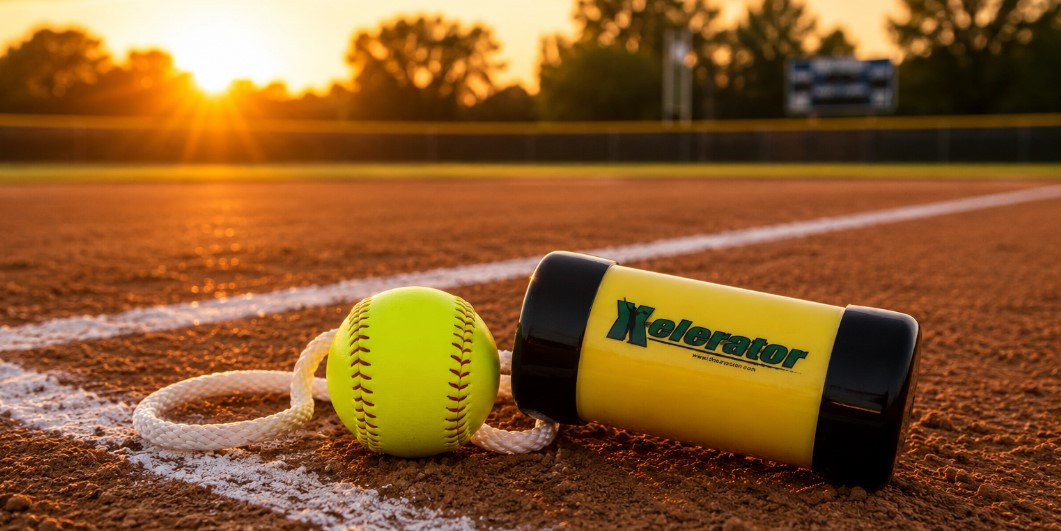
I had a young pitcher, 11 years old, come to me from another pitching coach just the other day. And while her mechanics are very solid, I asked her to show me her fastpitch pitching warm-up, and she grabbed her Composite Xelerator with the 12-inch leather ball and just started zipping it around as a warm-up tool. I suggested that the first thing she should do to dynamically warm up is arm circles, then throw overhand, then into a progressive pitching motion, from flicks to Ks or mediums to walk-throughs, etc., then on to full distance pitching. And if she’s going to use this tool as one of her pitching tools, I recommend it more as a training or strength-building implement than a warm-up implement, because it weighs a lot more than a regular softball.
And here’s a little more detail on all my thoughts regarding this:
- A regulation 12-inch softball weighs about 6.25–7 oz.
- A 16 oz training implement is more than twice the mass.
- In a windmill pitch, the shoulder experiences substantial rotational forces. Increasing the mass increases the torque required to accelerate and, importantly, decelerate the arm.
- At the beginning of practice, the rotator cuff, scapular stabilizers, connective tissues, and nervous system are not yet fully prepared for high-load, high-speed movements.
From a sports performance standpoint, most warm-up progressions follow this pattern:
- Increase body temperature.
- Activate the shoulder and scapular muscles.
- Gradually increase arm speed.
- Perform full-speed throws or pitches.
- Introduce overload work, if appropriate.
That progression minimizes sudden loading of cold tissues.
Where I would use a pitching device like this
If I were designing a pitching strength-building session, working on correcting an arm circle hitch, or focusing on increasing velocity, I’d be much more comfortable using it:
- After the pitcher has completed a full dynamic warm-up.
- After light throws or warm-up pitches.
- During a dedicated strength or overload block.
- In small volumes with good mechanics.
- Not every day.
Using it as the very first thing a pitcher does would make me more cautious, particularly with younger athletes.
Age of the pitcher matters somewhat
For 10U, 12U, even most 14U pitchers, I would be especially conservative because they’re still developing strength, coordination, and tissue tolerance.
For mature high school or college pitchers with good mechanics and a structured training program, overload implements may have a place—but they still don’t replace a proper warm-up.
One thing I’d emphasize
The greater concern may not even be the static weight—it’s the combination of weight and speed. The force on the shoulder isn’t determined solely by weight. A heavier object moving at high speed in a circular path increases the rotational demands on the shoulder, elbow, and trunk. That’s why coaches are often cautious about introducing weighted implements before athletes are thoroughly warmed up.
Based on current sports medicine principles, I would view a 16-ounce pitching trainer as a training implement rather than a warm-up implement. I would want the shoulder and the rest of the kinetic chain prepared first with progressive movement and normal throwing or pitching before introducing additional load. That position is consistent with general overload-training principles, even though there isn’t strong published evidence specifically evaluating this particular softball training aid as a warm-up tool.